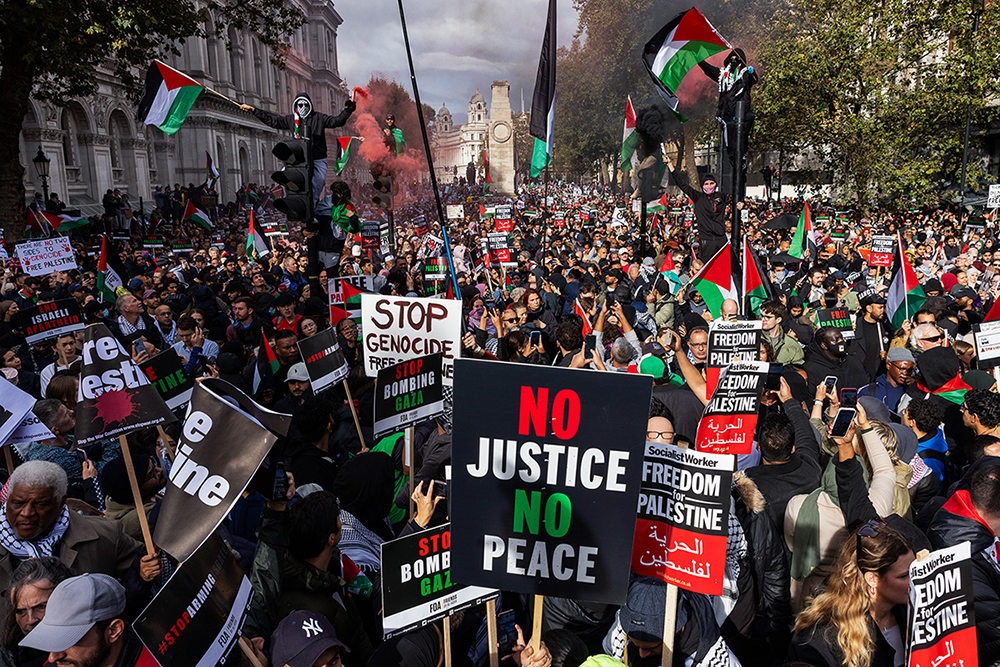
Today, Saturday, September 7th, London will witness the 19th national march since the genocide in Gaza began last October. The demonstration will highlight several key demands, including:
– A renewed call to end the ongoing genocide in Gaza.
– The immediate and full cessation of arms supplies to Israel.
For the first time, the protest will also prominently feature a call to combat the rising tide of Islamophobia in the UK, following recent far-right riots fueled by false rumours targeting the Muslim community.
Adnan Hmidan, Vice President of the Palestinian Forum in Britain, emphasised the organisers’ determination to proceed with the protest, despite pressure from various quarters. “This is the least we can do for our people who are being annihilated in Gaza every minute. They are also facing brutal treatment in the West Bank. We protest peacefully, and for the past eleven months, not a single person has been harmed during our demonstrations. Our struggle is against the occupation, not any individual or group. Here in Britain, we are standing in solidarity to apply political and public pressure to help stop the aggression,” Hmidan said.
The march is set to begin at 12 PM from Regent Street, near St. James’, heading toward the Israeli Embassy. This event follows considerable pressure and persistence from the UK-based pro-Palestine coalition, which organised the protest and successfully forced British police to retract restrictions on the time and location of the march. The office of the Mayor of London and several MPs also played a key role in pushing back against these limitations.
Organisers, including the Palestine Solidarity Campaign, the Palestinian Forum in Britain, Friends of Al-Aqsa, Stop the War Coalition, the Muslim Association of Britain, and the Campaign for Nuclear Disarmament, had previously described the restrictions as an infringement on the protesters’ rights. They pointed out that they had informed the police of their plans for the September 7th protest as early as August 8th.
The organisers have also criticised the police’s recent handling of the situation, noting that scheduled meetings with law enforcement have often been cancelled at the last minute. They described the police’s approach as increasingly “confrontational” since the protests began last year.
Observers hope that the police’s decision to ease some of the restrictions may help de-escalate rising tensions between the authorities and protesters. These protests are part of a larger series of pro-Palestinian demonstrations that have been taking place regularly in London since the onset of the genocide in Gaza last October, with tens of thousands of participants joining the marches.
This Saturday’s protest will be the first in nearly a year to march directly toward the Israeli Embassy in Kensington, West London. However, the event will coincide with a counter-protest organised by a pro-Israeli group calling itself “Stop Hate UK,” which has aimed to disrupt the national protest and pressure police into imposing further restrictions.
In previous demonstrations, the police imposed restrictions around the Israeli Embassy, giving them the authority to arrest anyone attempting to protest in its vicinity. According to recent police directives, the gathering points and routes for Saturday’s march have been specified, starting from Regent Street and heading toward Kensington, south of Hyde Park. Protesters will be barred from entering the street where the Israeli Embassy is located and a designated area on Kensington High Street.
End
07/09/2024