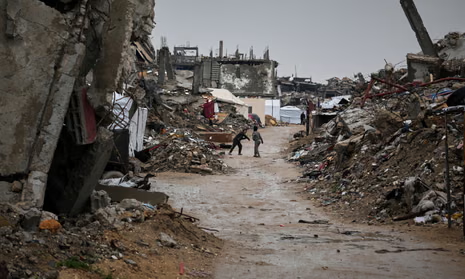
For two years Gaza has been a landscape of ruins, a place where ordinary lives have been cleaved in half by relentless bombardment, blockade and deprivation. In that time, ordinary people, fathers, mothers, children, the elderly and the disabled, have endured a catalogue of injustices: homes turned to rubble, hospitals paralysed, medicines and clean water cut off, and the simple human dignity of daily life denied. Against that backdrop, the steadfastness shown by those who remained has been nothing short of extraordinary. Their endurance is not a political trophy; it is a human testament to courage under conditions no one should have to bear.
Yet recent headlines about a phased agreement must not lull us into mistaking a tactical pause for a just or durable resolution. From a Palestinian perspective, the deal – even where it wins temporary reprieves – carries dangerous costs and exposes deep injustices that remain unaddressed.
First, there is the raw imbalance of power. A people under siege, surviving on dwindling supplies and improvised medicine, face off against one of the most heavily armed states on the planet. That asymmetry extends beyond the battlefield: it is political, economic and legal. When the international system funnels weapons, political cover and diplomatic protection to one party while consigning the other to blockade and isolation, it actively shapes the conditions that allow collective punishment to continue. The result is not a “conflict” between equals but a humiliation and impoverishment inflicted on a trapped civilian population.
Second, the terms and mechanics of any phased agreement reflect the limits of what vulnerable communities can hold in negotiation. Relying on a single leverage point – the fate of prisoners – to unlock wider obligations is precarious. Such a barter effectively turns human lives into the sole currency available in a room where legal guarantees and enforceable international mechanisms are scarce. When that currency is exchanged without robust, independent safeguards, there is a real risk that the supposed progress will be temporary: an uneasy interval before violence resumes, or before new conditions of control are imposed.
Third, the broader diplomatic environment offers little comfort. Support for oppressive measures has been displayed on many international stages. Political and military alliances, arms transfers, and the media environments that shape public debate have systematically favoured certain actors, even as they claim neutrality. This imbalance is compounded when erstwhile friends and regional governments, under realpolitik pressure or ideological alignment, either withdraw support or become instruments of containment rather than advocates of justice. The Palestinian experience has been to endure both active hostility and the cold betrayal of abandonment.
Fourth, the agreement’s downstream implications could be severe. Among the gravest concerns is the prospect of foreign forces or internationalised security arrangements being authorised to enter and administer Gaza under the guise of “stability.” For Palestinians, history offers stark lessons about occupations and prolonged external control that erode sovereignty, subject populations to surveillance and punishment, and restrict the possibility of genuine self-determination. The transfer of control, even partial, risks institutionalising new forms of domination under an international imprimatur rather than dismantling the conditions of siege.
Fifth, there is the domestic fallout in the diaspora and in sympathetic communities abroad. When negotiations are perceived as capitulation or when external actors weaponise legal and media systems to crush solidarity, defenders of Palestinian rights may find their civic space narrowed. The recent period has already seen an intensification of efforts to silence dissent, from censorship and legal pressure to economic and social intimidation. Those who speak for Gaza are therefore not only advocating for the besieged; they are resisting a creeping international effort to normalise injustice by delegitimising those who call it out.
Against these dangers, the Palestinian narrative insists on principles that cannot be bartered away. The first is the right to life and dignity; the second is the right to return and rebuild; the third is the right to know the fate of the missing and the detained under transparent, independent mechanisms; and the fourth is the right to live without siege and blockade. Short-term humanitarian relief, welcome though it is, cannot substitute for those fundamental rights.
So what would a just path look like from this vantage point? It would begin with guarantees that are enforceable and international, not dependent on the goodwill of those who have repeatedly broken their promises. It would include independent international monitoring of any releases or ceasefires, unimpeded access for humanitarian agencies, the immediate lifting of sieges that prevent medical care and reconstruction, and credible, time-bound mechanisms for accountability for crimes against civilians. Crucially, it would require a shift in the regional and global political calculus: a move away from instrumentalising Palestinian lives as bargaining chips, and toward recognising the Palestinian claim to freedom, dignity and self-determination as an urgent international priority.
None of this is easy. The remedies are large and costly, politically and materially, and they demand courage from governments and societies unused to challenging entrenched geopolitical alignments. But the alternative is a repetition of catastrophe: a return to daily death and displacement, a deepening of statelessness and trauma, and the erosion of any hope for justice.
And yet, amid the darkness, there is a defiant truth: Palestinians have not merely survived; they have borne witness. Their endurance has a moral force that no weapon can erase. It compels the world to look again at the architecture of power and ask whether the institutions meant to protect humanity are fit for purpose.
In the United Kingdom, this moment must not be seen as an endpoint but as a renewal of purpose. The movement for Palestine has grown into one of the largest and most enduring moral causes of our time, uniting people of all faiths, backgrounds and generations. The ceasefire should not quiet the streets, but inspire an even deeper commitment to justice, accountability, and rebuilding Gaza. British civil society, student unions, trade unions, faith groups and campaigners must continue to press for an end to arms sales to Israel, for sanctions on war crimes, and for genuine political pressure that aligns Britain with international law, not with impunity. Activism must go on, because the siege is not over, the wounds are not healed, and silence helps only the oppressor.
We pray that what has been signed becomes the first step toward a real, enforceable end to suffering, not a cover for a return to war or a prelude to new forms of control. Until then, the call from Gaza is simple and unadorned: end the siege, ensure genuine safety for civilians, bring home those detained, and allow the Strip to breathe again. Anything less is not peace; it is merely the quiet before another storm.